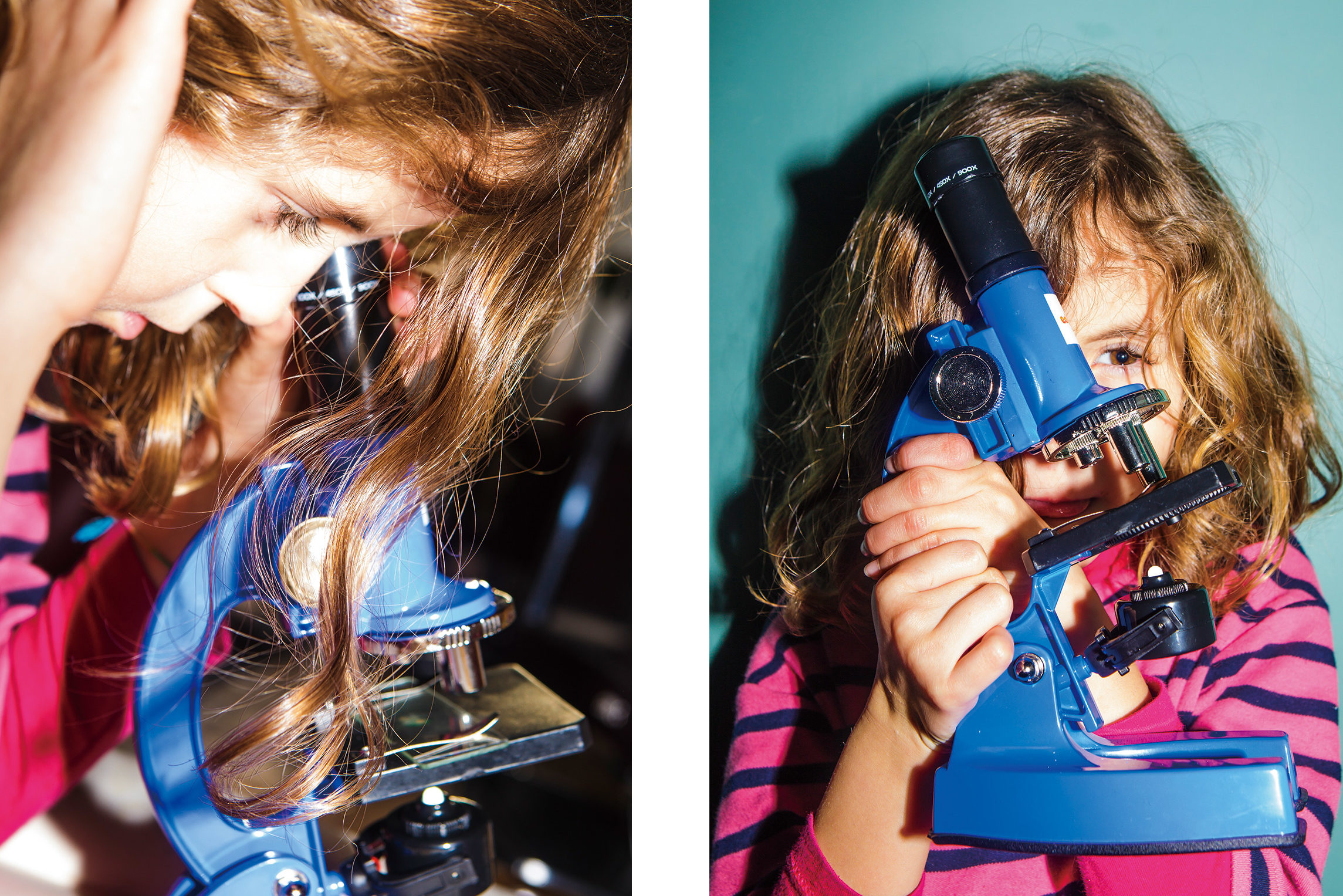
Science has many women
Source: Looks with Alma
Arriving in 2019, it no longer seems strange to us—fortunately—that a woman is a surgeon, works as an engineer or becomes an astronaut. That is why it is shocking that in science, mathematics and technology classes in high schools, the presence of girls is still very small. The project Hypatia, coordinated in Spain by the Scientific Disclosure Area of CosmoCaixa, has not stopped directing activities during the last three years to attract 15- to 18-year-old girls to careers previously considered "for boys". And on the occasion of the International Day of Women and Girls in Science, we have spoken to its real protagonists.
Yasmin and Mercedes study 4º of the ESO at Colegio Padre Damián in Barcelona and want to be doctors. They spend their nights looking at “disease books” and their days, applying themselves thoroughly in class. They know that they have many years of study ahead of them, but they do not plan to give up on their dream. Receive the visit of two scientists from the only particle accelerator in Spain, ALBA synchrotron, and knowing their stories has given them the push they needed. "One of them told us that in high school she was very bad at science but that she worked hard until she passed, and that when she managed to study physics at university she was the only girl in her class and it was not easy. so that if she can, so can I”, says Mercedes.
I would have liked to attend a 'Café científico' as organized by Hypatia when I was young", confesses Victòria Agulló, biologist and teacher of the girls. "Listening to these women makes you feel more confident that you can do it, because you're going to someone who has already achieved it." This biology and mathematics teacher attributes the lack of girls in classes related to STEM (Science, Technology, Engineering and Mathematics) to several factors: "They don't have engineer mothers, but engineer fathers. We still drag that. And then there is the difficulty. That's why they have to work hard and take responsibility, so they can see that overcoming difficulty has reward". In fact, his message is already starting to take effect: "I prefer to study twelve years but be able to devote myself to something I like than four to something I don't want to do." In the future, I want to be able to say that I'm happy with what I do and that it was worth it", says Yasmin with conviction.
Both the Padre Damián School and the ALBA Synchrotron were part of it hub Spanish of this European project together with some museums, foundations and other entities. In the case of the Synchrotron, its role was so important to treat the only accelerator of its kind directed by a woman—Caterina Biscari—as well as because of the direct impact that her research has on people's lives. One of his latest discoveries: the changes that amyotrophic lateral sclerosis (ALS) causes in the cells, which allow us to know, finally, what type of drugs or treatments we can begin to apply against the disease.
"When I was in high school, I dreamed of working in an accelerator," Debora Pierucci, a scientist at the Cerdanyola del Vallès Synchrotron and specialist in materials science, tells us. "It's fascinating: a circle where you put small particles and the centrifuges very fast so that, when they reach the speed of light, they release rays that, applied to the samples, allow us to study what we want: materials, chemical reactions, the environment (for e.g. water pollution), cultural heritage (especially in restoration processes)... Every year 2,000 researchers pass through here to use it. Now with my team we are studying materials "sisters" of graphene and how to combine them, which will be very useful in the development of electronic devices of the future, such as mobile phones or cameras", reveals the researcher at the head of the LOREA line.
"The best thing about going to talk to the students of Colegio Padre Damián was explaining to them how the accelerator works" - he continues - "and how the life of a researcher is, because we are seen as people with a very different life, when in reality it is a normal life with a very interesting job that we enjoyed a lot. I wanted to convey my passion to them, particularly to the girls, because I hope that in the future we will reach the same number of women as men in science, as in other types of work. When men and women are mixed, we do a better job."
The Hypatia project, financed by the European Commission in the context of Horizon 2020, has finished his three years of life (2015-2018) with the duty fulfilled. Not only having contributed to bringing students closer to STEM careers, communicating science to young people in an inclusive way and getting schools, museums and institutions to do the same, but also having exceeded all expectations , reaching almost 15,000 students in Spain (of the 10,000 expected), 632 teachers (of 582 expected) and 171 institutions (of the expected 165). And that, in a future full of jobs that will demand STEM skills, in which we cannot afford to do without half the population, is good news for everyone.
Photography: Roman Yñán